

Milkworts
Polygala spp.
Family: Polygalaceae
Examples: P. serpyllifolia; P. vulgaris
Fire effect on plant
Milkworts are likely killed by fire.
Key traits
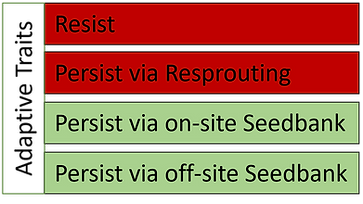
Milkworts are herbaceous perennials that regenerate exclusively from seed after fire. Studies in UK heathlands found milkworts did not resprout after fire, but instead relied on a soil-stored seedbank (Mallik and Gimingham 1983; Reader et al. 1984). Recruitment was rapid in the post-fire environment, with milkworts present within 3 months of a burn (Mallik and Gimingham 1983). Seed dispersal in Milkworts is primarily via ants, with moderate dispersal distances (2–15m; Lososová et al. 2023).
Plant response to fire
Low-intensity fire appears to benefit milkwort populations in the short- to medium-term through the reduction of competition and increase in light availability. In a Norwegian healthand, milkwort peaked in abundance 6-8 years after a controlled burn (Måren and Vandvik 2009), before declining, presumably due to competition from late-succession species.
Timing of life history
Perennial species. Seeds likely produced from second growing season. Flowering April until June.
Conservation status
None.
References
Reader, R. J., Mallik, A. U., Hobbs, R. J., and Gimingham, C. H. 1984. Shoot Regeneration after Fire or Freezing Temperatures and Its Relation to Plant Life-Form for Some Heathland Species. Vegetatio 55: 181–189. [Empirical evidence; Academic literature]
Mallik, A. U., and Gimingham, C. H. 1983. Regeneration of Heathland Plants following Burning. Vegetatio 53: 45–58. [Empirical evidence; Academic literature]
Måren, I.E. and Vandvik, V. 2009. Fire and regeneration: the role of seed banks in the dynamics of northern heathlands. Journal of Vegetation Science 20: 871-888. [Empirical evidence; Academic literature]